How to Become a SOC Analyst in 2026 (Step-by-Step Guide)
If you want to break into cybersecurity in 2026, becoming a SOC Analyst is one of the smartest career moves you can make. SOC (Security Operations Center) Analysts are the first line of defense for organizations — monitoring, detecting, and responding to cyber threats 24/7.
With cybercrime damages crossing $12 trillion globally and a worldwide shortage of 4 million cybersecurity professionals, companies are hiring SOC Analysts faster than ever before.
In this complete step-by-step guide, you'll learn:
- What a SOC Analyst actually does
- The 3 tiers of SOC roles
- Skills you need to master
- Best certifications for 2026
- Tools used in real SOC environments
- Salary expectations worldwide
- A complete roadmap from zero to hired
Whether you're a fresher, IT professional, or career switcher — this guide will give you the exact path to land your first SOC job in 2026.

1. What is a SOC Analyst?
A SOC Analyst (Security Operations Center Analyst) is a cybersecurity professional responsible for monitoring an organization's IT infrastructure to detect, analyze, and respond to security incidents in real-time.
Think of SOC Analysts as the digital security guards of a company — watching dashboards, investigating alerts, and stopping cyberattacks before they cause damage.
What Does a SOC Analyst Do Daily?
- 🚨 Monitor SIEM dashboards for security alerts
- 🔍 Triage and investigate suspicious activities
- 📊 Analyze logs from firewalls, endpoints, and servers
- 🛡 Respond to phishing emails and malware infections
- 📝 Document incidents and create reports
- 🤝 Collaborate with IR, threat hunting, and IT teams
- 🔄 Tune detection rules to reduce false positives
Why SOC Analyst is a Great Career in 2026
- 💼 High demand — Every company needs a SOC
- 💰 Good salary — Entry-level $60K+ globally
- 📈 Clear growth path — Tier 1 → Tier 2 → Tier 3 → Manager
- 🌍 Remote opportunities — Many SOCs operate globally
- 🎓 No degree required — Skills + certs matter more
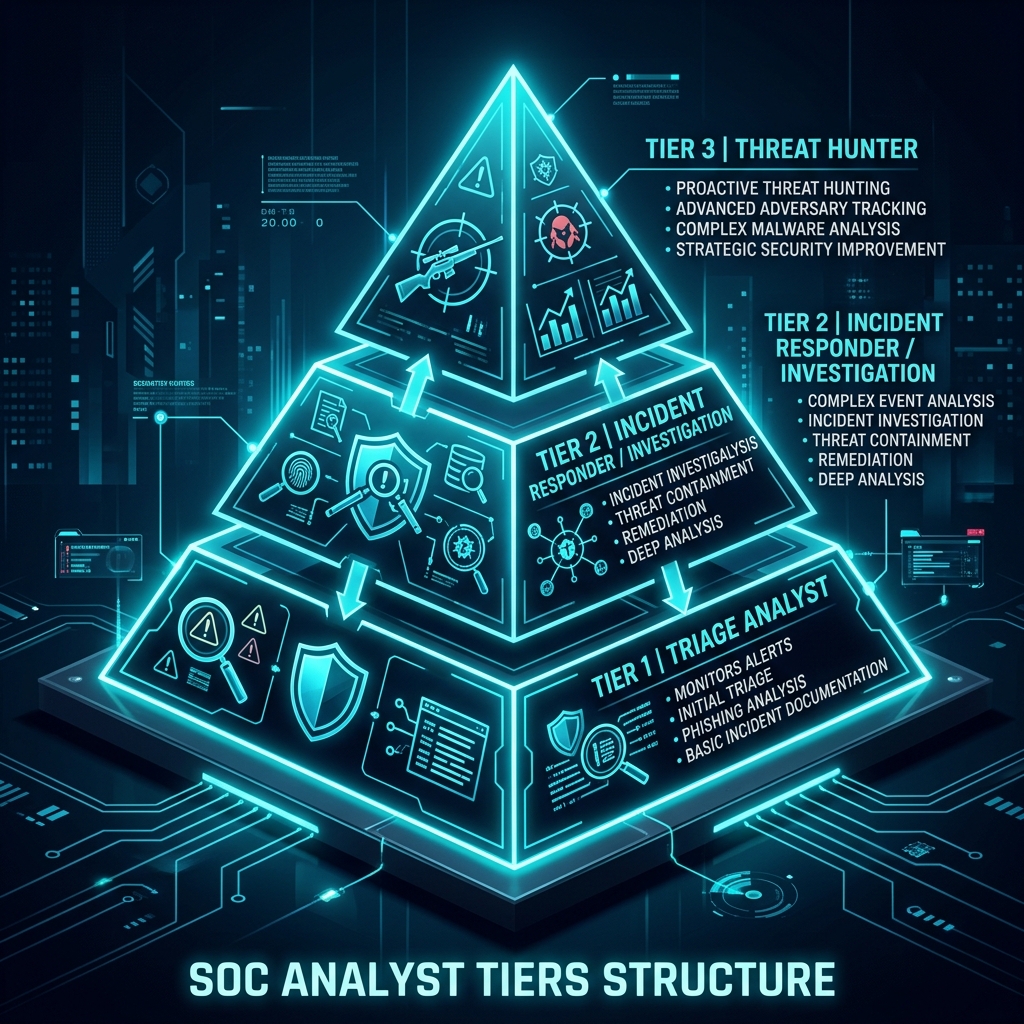
2. The 3 Tiers of SOC Analysts
Most SOCs follow a 3-tier model. Understanding this helps you plan your career:
🔹 Tier 1 — SOC Analyst (Triage)
Role: Entry-level. Monitors alerts, performs initial triage, escalates real threats.
Experience: 0–2 years | Salary: $55K–$80K
Skills: SIEM basics, log analysis, ticketing tools
🔹 Tier 2 — SOC Analyst (Investigation)
Role: Deep-dive investigation of incidents escalated from Tier 1. Performs forensics, malware analysis, and incident response.
Experience: 2–5 years | Salary: $85K–$120K
Skills: Advanced log analysis, EDR tools, scripting
🔹 Tier 3 — Threat Hunter / Senior Analyst
Role: Proactively hunts for hidden threats, develops detection rules, leads major incident response.
Experience: 5+ years | Salary: $130K–$180K+
Skills: Threat intelligence, MITRE ATT&CK, custom detections, scripting
3. Skills You Need to Become a SOC Analyst
🧠 Foundational Skills
- Networking Fundamentals: TCP/IP, OSI Model, DNS, HTTP/HTTPS, subnetting, routing, switching, and common ports.
- Operating Systems: Windows internals, Active Directory, Linux command line, file systems, permissions, event logs, and processes.
- Security Fundamentals: CIA Triad, common attack vectors (phishing, malware, ransomware), OWASP Top 10, Cyber Kill Chain, and the MITRE ATT&CK Framework.
🛠 Technical Skills
- SIEM Platforms: Splunk, ELK, QRadar, and Microsoft Sentinel.
- Log Analysis: Reading Windows Event Logs, Syslog, and firewall logs to track attacker footprints.
- EDR/XDR Tools: CrowdStrike, SentinelOne, and Microsoft Defender for Endpoint.
- Packet Analysis: Wireshark and tcpdump.
- Scripting: Python, PowerShell, or Bash for automation.
- Threat Intelligence: VirusTotal, AbuseIPDB, and MISP.
💬 Soft Skills
- Strong communication (essential for incident reporting).
- Analytical and critical thinking under high pressure.
- A continuous learning mindset (cybersecurity shifts daily).
4. Education — Do You Need a Degree?
Short answer: No, but it helps.
Most SOC jobs prefer:
- 🎓 Bachelor's degree in CS, IT, or Cybersecurity (preferred but not mandatory)
- 📜 Industry certifications (often more valuable than degrees)
- 💻 Hands-on lab experience
- 🏆 Real projects or CTF participation
Many successful SOC Analysts in 2026 are self-taught using free resources, certifications, and home labs.
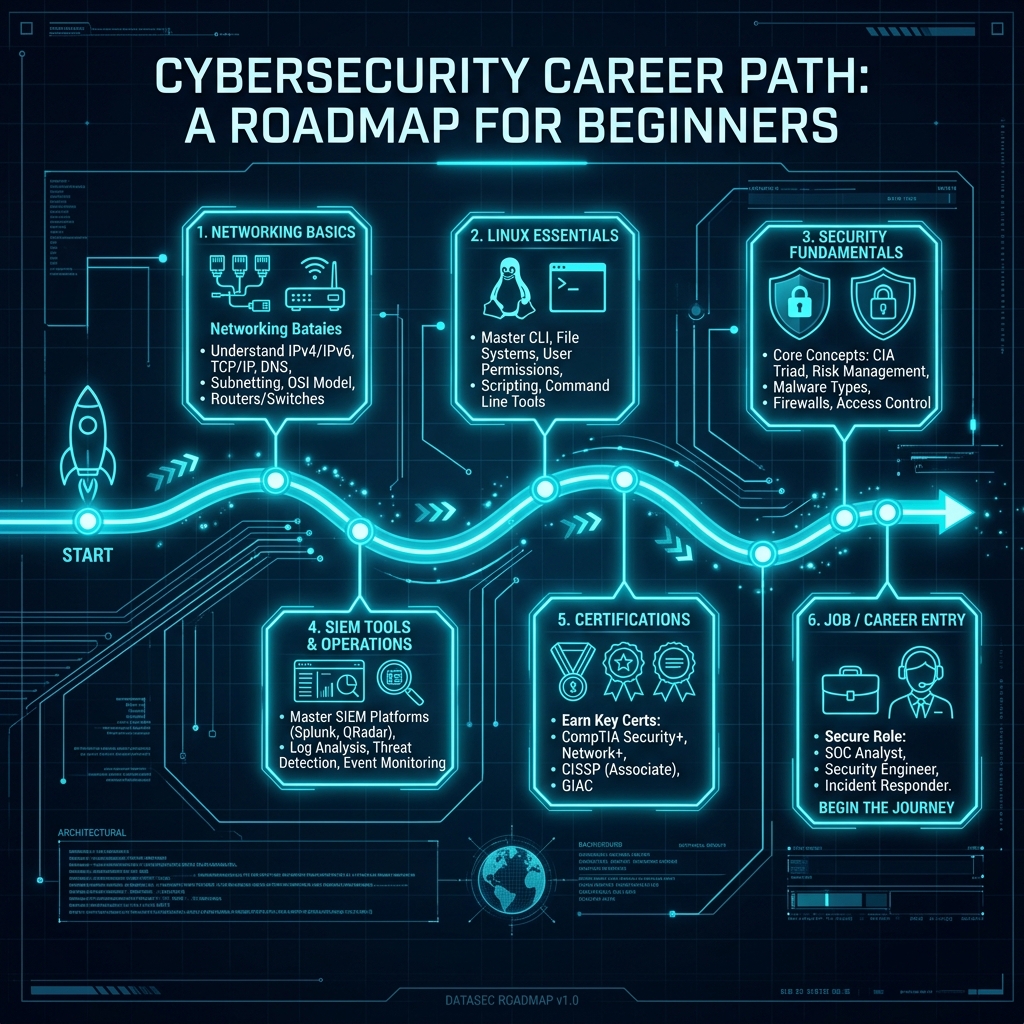
5. Step-by-Step SOC Analyst Roadmap (2026)
Here's your exact 6-month roadmap to become job-ready:
Month 1: Networking & OS Basics
Learn TCP/IP, DNS, HTTP, ports. Practice Linux commands daily. Understand Windows Event Viewer.
Resources: Professor Messer (free), TryHackMe "Pre-Security" path
Month 2: Security Fundamentals
Study CIA triad, attack types, malware basics, and MITRE ATT&CK framework. Read about real-world breaches.
Resources: TryHackMe "SOC Level 1", CompTIA Security+ study guide
Month 3: SIEM & Log Analysis
Install Splunk Free or Wazuh/ELK Stack at home. Practice analyzing Windows Event Logs. Learn Sysmon.
Resources: Splunk Fundamentals 1 (free), BlueTeamLabs.online
Month 4: Incident Response & Tools
Learn EDR concepts (CrowdStrike, Defender). Practice phishing email analysis. Study malware behavior basics.
Resources: LetsDefend.io, CyberDefenders.org
Month 5: Certifications
Start preparing for one entry-level cert (Security+, CCD, or BTL1). Build a home SOC lab and document it.
Resources: GitHub, LinkedIn
Month 6: Job Hunt
Build LinkedIn profile with SOC keywords. Create a strong resume with home lab projects. Apply to entry-level SOC, NOC, or IT Security roles.
Resources: LetsDefend, LinkedIn Jobs
6. Top Tools Every SOC Analyst Must Know
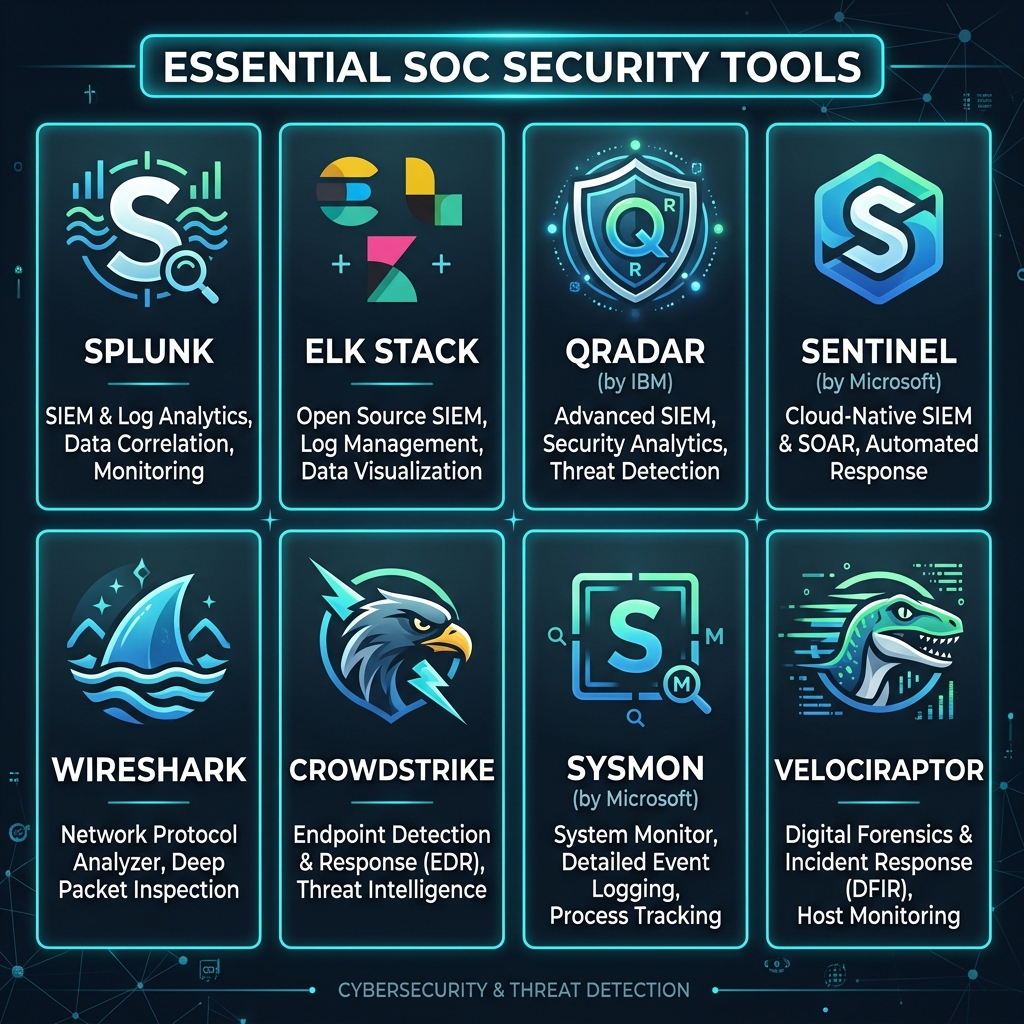
SOC Analysts rely on standard defensive frameworks and tooling:
- 🛡 SIEM Platforms: Splunk, IBM QRadar, Microsoft Sentinel, ELK Stack, and Wazuh.
- 🔍 EDR/XDR Tools: CrowdStrike Falcon, SentinelOne, Microsoft Defender for Endpoint, and Carbon Black.
- 📊 Analysis Tools: Wireshark (packet analysis), Sysmon (Windows logs), Velociraptor (forensics), and Volatility.
- 🌐 Threat Intelligence: VirusTotal, AbuseIPDB, MISP, and AlienVault OTX.
- 🧪 Practice Platforms: LetsDefend.io, CyberDefenders.org, TryHackMe, and BlueTeamLabs.online.
7. Best Certifications for SOC Analysts in 2026
Foundations
CompTIA Security+, CompTIA CySA+, EC-Council CSA, Blue Team Level 1 (BTL1), and Microsoft SC-200.
Core Competency
GIAC GCIA (intrusion analysis), GIAC GCIH (incident handling), Blue Team Level 2 (BTL2), and Splunk Core Certified User.
Specialization
GIAC GCFA (forensics), GIAC GNFA (network forensics), OffSec OSDA (defense), and CISSP for management.
8. SOC Analyst Salary Worldwide (2026)
SOC Analysts command strong compensation packages globally. Here are the 2026 average salary scales:
| Region | Entry-Level | Mid-Level | Senior |
|---|---|---|---|
| 🇺🇸 USA | $65K–$85K | $95K–$130K | $140K–$190K |
| 🇬🇧 UK | £35K–£50K | £55K–£75K | £85K–£120K |
| 🇨🇦 Canada | C$60K–$80K | C$90K–$120K | C$130K–$170K |
| 🇮🇳 India | ₹4–8 LPA | ₹10–18 LPA | ₹20–40 LPA |
| 🇦🇪 UAE | AED 120K–180K | AED 200K–300K | AED 350K–500K |
| 🇦🇺 Australia | A$70K–$95K | A$100K–$140K | A$150K–$200K |
9. Building Your Home SOC Lab (Free)
Practice is what gets you hired. Build a free home lab:
- 🖥 Virtualization: VirtualBox or VMware Player.
- 🐧 Ubuntu Server: For hosting your ELK or Wazuh instance.
- 🪟 Windows 10 VM: Endpoint configured with Sysmon and Winlogbeat.
- 🔥 pfSense: Open-source firewall to track network packets.
- 📊 Splunk Free / Wazuh / ELK: Your core SIEM dashboard.
- 🎯 Atomic Red Team: For simulating real attack behaviors.
Project Ideas to Build Your Portfolio:
- Detect a brute force login attack using custom Splunk dashboards.
- Analyze a simulated phishing email, extract header artifacts, and locate malicious IPs.
- Write a custom Sigma detection rule for anomalous PowerShell execution.
- Investigate a simulated Ransomware deployment and map it to MITRE ATT&CK.
10. Common SOC Analyst Interview Questions
Prepare these standard concepts for your first technical interview:
- ❓ What is the difference between IDS and IPS?
An IDS (Intrusion Detection System) only monitors and alerts, whereas an IPS (Intrusion Prevention System) actively blocks matching traffic. - ❓ Walk me through how you'd investigate a phishing email.
Analyze mail headers (SPF, DKIM, DMARC), submit attachments to sandboxes (VirusTotal), look up IP reputations, and trace if any internal users opened links. - ❓ What is MITRE ATT&CK and how do you use it?
A globally accessible knowledge base of adversary tactics, techniques, and procedures (TTPs). It's used to map system detections to specific attacker actions. - ❓ Explain the difference between TCP and UDP.
TCP is connection-oriented, reliable, and uses a 3-way handshake. UDP is connectionless, faster, but does not guarantee delivery. - ❓ How would you detect lateral movement?
Monitor active Windows events like ID 4624 (successful logon type 3/network) or suspicious WinRM/WMI activity across workstation IPs.
11. Common Mistakes Beginners Make
- ❌ Only watching tutorials without hands-on practice.
- ❌ Ignoring fundamental IT systems (networking protocols, Windows registry, Linux commands).
- ❌ Attempting to obtain too many certifications at once instead of prioritizing one practical lab exam.
- ❌ Maintaining a resume lacking lab write-ups or a GitHub documentation portfolio.
- ❌ Neglecting soft skills like technical report writing and team communication.
12. The Future of SOC Analysts (2026 & Beyond)
The SOC architecture is evolving rapidly:
- 🚀 AI-Powered SOCs: AI models handle entry-level alert triage; humans focus on root-cause analysis and threat hunting.
- 🚀 Cloud SIEM Domination: Microsoft Sentinel, Google Chronicle, and Splunk Cloud are replacing legacy on-prem infrastructure.
- 🚀 SOAR Integration: Security Orchestration, Automation, and Response playbooks automate repetitive alerts.
- 🚀 Threat Hunting Focus: Transitioning from passive monitoring to proactive threat searching.
SOC Analysts who master AI + Cloud + Threat Hunting will be the most valuable assets in 2026.
Conclusion
Becoming a SOC Analyst in 2026 is one of the best entry points into cybersecurity — combining high demand, good pay, and a clear career path.
The roadmap is simple:
- Build strong fundamentals (networking, OS, security)
- Get hands-on with SIEM tools
- Earn one solid certification
- Build a home lab and document everything
- Apply, interview, and start your journey
You don't need a fancy degree or years of experience. What you need is consistency, curiosity, and hands-on practice. The cyber world needs defenders. Will you be one of them? 🛡
👉 Next Step: Read our Penetration Testing Guide 2026 to understand the attacker's side, and check out Top 15 Free OSINT Tools 2026 every analyst must know.
Frequently Asked Questions (FAQ)
About the Authors
Written by the Hackers in Threat Hunt Team. We are a collaborative force of certified ethical hackers (OSCP, eWPTX, PNPT) specializing in network penetration testing, application security audits, and threat emulation. Our goal is to secure enterprise infrastructure by hacking it first.