MITRE ATT&CK Framework Explained with Real Examples (2026 Guide)
If you're serious about cybersecurity in 2026 — whether as a SOC Analyst, threat hunter, red teamer, or incident responder — there's one framework you absolutely must master: MITRE ATT&CK.
MITRE ATT&CK has become the global standard for understanding how real-world attackers operate. It's used by every major SOC, threat intelligence team, EDR vendor, and red team across the world.
But for beginners, it can look overwhelming — a massive matrix with hundreds of techniques and confusing terminology. This guide breaks it down in plain English with real-world examples.
You'll learn:
- What MITRE ATT&CK is and why it matters
- The 14 tactics and how they map to attacks
- Real techniques used by APT groups
- How to use ATT&CK for threat hunting & detection
- Tools and platforms built around it
- A practical attack walkthrough using ATT&CK mapping
Let's dive in. 🎯
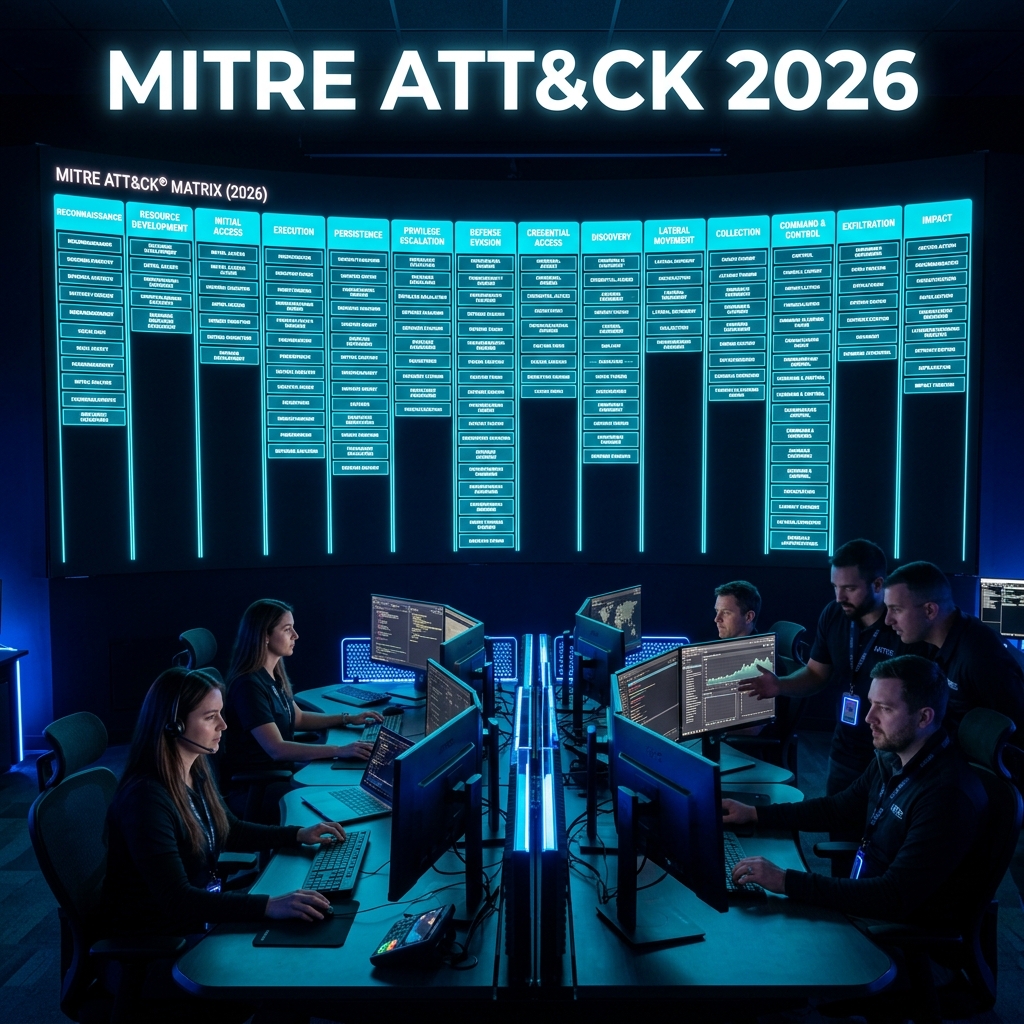
1. What is MITRE ATT&CK?
MITRE ATT&CK stands for Adversarial Tactics, Techniques, and Common Knowledge.
It's a globally accessible knowledge base of real-world cyberattack behaviors, created and maintained by the MITRE Corporation (a non-profit working with the US government).
In simple words: It's a giant catalog of how hackers attack systems — based on what's actually happened in real breaches.
Why MITRE ATT&CK is a Game-Changer
- 🌍 Used by 90%+ of enterprise SOCs worldwide
- 🛡 Standardizes how defenders talk about attacks
- 🎯 Helps map detections to real adversary behavior
- 🧠 Free, open, and continuously updated
- 🤝 Adopted by tools like Splunk, Sentinel, CrowdStrike, Defender
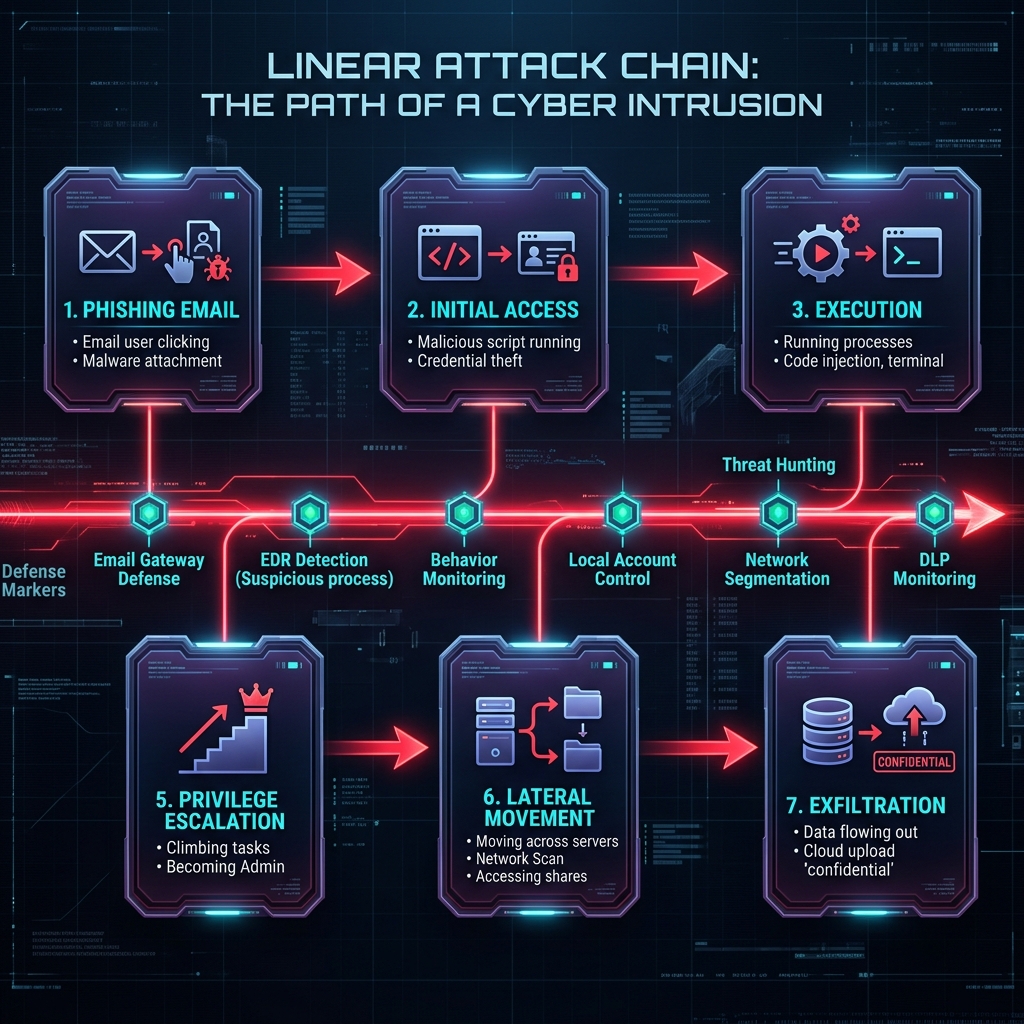
MITRE ATT&CK vs. Cyber Kill Chain
- Cyber Kill Chain (Lockheed Martin): 7 high-level sequential phases of an overall attack.
- MITRE ATT&CK: Hundreds of detailed techniques showing exactly HOW attacks happen.
Kill Chain = the story. ATT&CK = the playbook.
2. The Structure of MITRE ATT&CK
MITRE ATT&CK is organized into 3 levels:
🎯 Tactics (The "Why")
The attacker's goal at each step. Example: "Initial Access" or "Persistence." There are 14 tactics in the Enterprise matrix.
🛠 Techniques (The "How")
The method used to achieve a tactic. Example: "Phishing" (T1566) is a technique under "Initial Access."
🔬 Sub-Techniques (The "Specific How")
More detailed versions of techniques. Example: "Spearphishing Attachment" (T1566.001) is a sub-technique of "Phishing."
Additionally, the database lists Procedures, which represent real-world examples of how specific threat groups (like APT29 or Lazarus) executed a technique.
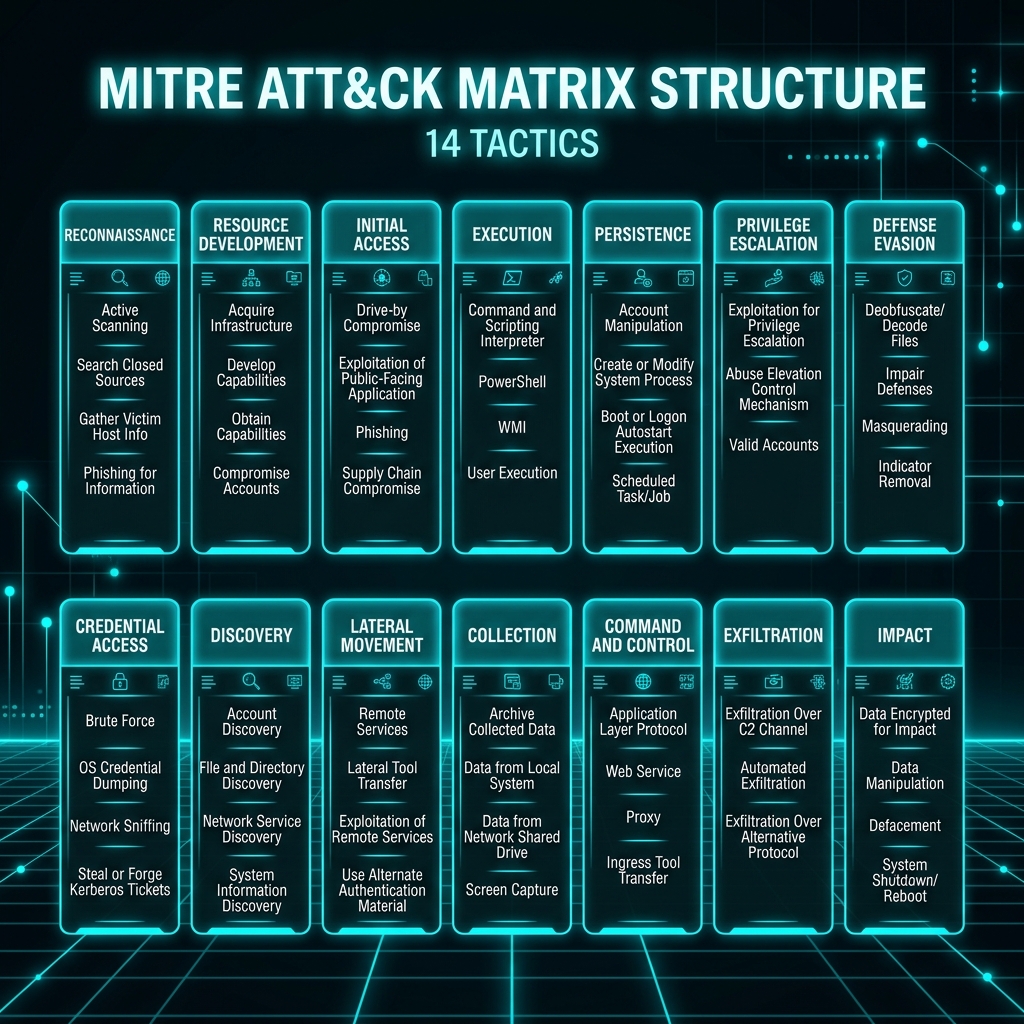
3. The 14 Tactics in MITRE ATT&CK Enterprise
Here is the full attack lifecycle of the 14 tactics:
- Reconnaissance — Gathering information about the target.
- Resource Development — Building infrastructure (such as registering domains or scripting malware).
- Initial Access — Penetrating the victim's network.
- Execution — Running malicious code on a target machine.
- Persistence — Maintaining a foothold in the compromised system (surviving restarts).
- Privilege Escalation — Elevating system permissions (e.g., getting local admin or SYSTEM rights).
- Defense Evasion — Evading detection (disabling security agents or obfuscating scripts).
- Credential Access — Accessing passwords, tokens, or credential databases.
- Discovery — Mapping out the compromised network architecture.
- Lateral Movement — Pivoting to other network servers and workstations.
- Collection — Gathering sensitive target files and database content.
- Command and Control (C2) — Communicating with the remote attacker server.
- Exfiltration — Stealing files and data from the network.
- Impact — Disrupting operations (encrypting files with ransomware or wiping drives).
4. Real Attack Example Mapped to MITRE ATT&CK
Let's walk through a realistic cyberattack scenario and map each phase to the corresponding MITRE ATT&CK framework components:
Attacker scrapes public directories to find internal IT email addresses.
Technique: T1589.002 — Gather Victim Identity Information: Email Addresses
Sends a targeted email containing a malicious Excel document.
Technique: T1566.001 — Spearphishing Attachment
The victim opens Excel, enabling macros which in turn execute a PowerShell loader.
Technique: T1059.001 — PowerShell
The PowerShell script writes a startup scheduled task to trigger the loader on login.
Technique: T1053.005 — Scheduled Task
Exploits a local Windows kernel vulnerability to elevate to SYSTEM privileges.
Technique: T1068 — Exploitation for Privilege Escalation
Executes Mimikatz to scrape active passwords out of LSASS memory.
Technique: T1003.001 — LSASS Memory
Pivots to the domain controller using Remote Desktop and the compromised admin credentials.
Technique: T1021.001 — Remote Desktop Protocol
Connects out from the Domain Controller to a cobalt strike C2 over secure HTTPS ports.
Technique: T1071.001 — Web Protocols
Compiles and compresses critical documents, uploading them to public cloud storage servers.
Technique: T1567.002 — Exfiltration to Cloud Storage
Triggers a ransomware script across all domain endpoints, encrypting disk databases.
Technique: T1486 — Data Encrypted for Impact
5. Famous APT Groups and Their ATT&CK Profiles
MITRE tracks over 140 advanced persistent threat (APT) groups. Here are a few prominent profiles:
🔴 APT29 (Cozy Bear)
Origin: Russia. Famous for the SolarWinds supply-chain breach.
TTP Focus: Spearphishing, custom C2 backdoors, abusing trusted relationships.
Key Techniques: T1566, T1059.001, T1078 (Valid Accounts).
🔴 Lazarus Group
Origin: North Korea. Known for cryptocurrency hacks and financial operations.
TTP Focus: Phishing attachments, custom file obfuscation, crypto wallet backdoors.
Key Techniques: T1566.002, T1027, T1486.
🔴 APT41
Origin: China. Espionage + financially motivated attacks.
TTP Focus: Software supply chain compromise, web shell deployment, RAM scraping.
Key Techniques: T1190, T1505.003, T1071.
🔴 LockBit
Type: RaaS (Ransomware-as-a-Service) cartel.
TTP Focus: System recovery inhibition, admin tool abuse, cloud exfiltration engines.
Key Techniques: T1486, T1490, T1567.
6. The Different MITRE ATT&CK Matrices
MITRE maintains multiple specialized matrices tailored for different technology stacks:
- Enterprise Matrix: Covering standard operating systems (Windows, macOS, Linux), network devices, container platforms (Docker, Kubernetes), and cloud environments.
- Cloud Matrix: Focused on SaaS, Azure AD, AWS IAM, GCP API endpoints, and cloud identity misconfigurations.
- Mobile Matrix: Dedicated to iOS and Android security architecture compromises.
- ICS Matrix: Focused on operational technology (OT) protocols, SCADA, PLCs, and power station operations.
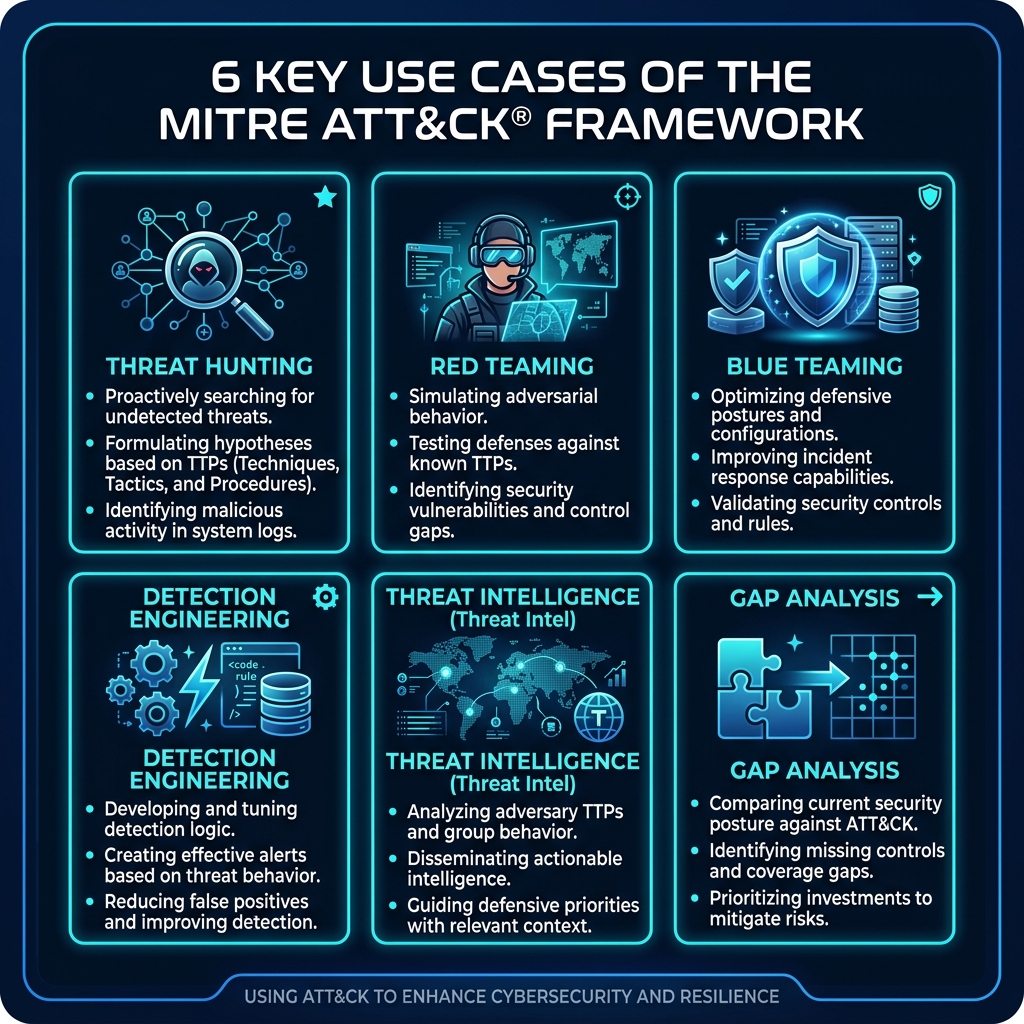
7. How to Use MITRE ATT&CK (Real Use Cases)
MITRE ATT&CK serves as the backbone of modern security operations:
- 🔍 Threat Hunting: Formulate hypothesis tests targeting specific techniques.
- 🛠 Detection Engineering: Write SIEM and endpoint queries mapped directly to techniques.
- 🛡 Blue Team Defense: Run security posture gap analysis to locate visibility blind spots.
- 🎯 Red Team Operations: Develop threat emulation scenarios imitating real threat actor scripts.
- 🌐 Threat Intelligence: Tag and share attacker indicator campaigns in a globally standardized syntax.
8. Top Tools That Use MITRE ATT&CK
- ATT&CK Navigator: A free interactive web tool to visualize coverage mapping.
- Atomic Red Team: A library of executable scripts to test endpoints against specific techniques.
- Caldera: MITRE's automated adversary emulation and attack simulation framework.
- Sigma Rules: Open-source generic detection templates mapped to technique IDs.
9. Step-by-Step: How to Start Threat Hunting with ATT&CK
Step 1: Pick a Technique
Choose one technique to hunt. Example: T1059.001 (PowerShell Script Execution).
Step 2: Understand the Behavior
Read the MITRE wiki page. Understand how attackers use PowerShell (such as using encoded base64 parameters to evade detection).
Step 3: Identify Data Sources
Look up what logs record this behavior. In this case, you need Windows Event ID 4104 (Script Block Logging) or Sysmon Event ID 1 (Process Creation).
Step 4: Build a Hunt Query
Write a query to parse commands for encoding flags.
Step 5: Investigate and Analyze
Review results. Determine if Word launching PowerShell matches legitimate internal administration scripts (highly unlikely) or represents active initial exploitation.
10. Common Mistakes to Avoid
- ❌ Treating ATT&CK as a checklist: Assuming that checking a technique off means you are 100% immune, ignoring procedure variations.
- ❌ Ignoring procedures: Focusing purely on generic technique titles without testing the exact technical implementation used by threat groups.
- ❌ Alert fatigue: Creating alerts for very broad, common techniques without contextual filtering, leading to thousands of daily false positives.
11. The Future of MITRE ATT&CK (2026 & Beyond)
Looking forward, the framework is expanding in the following domains:
- 🚀 AI-Aware Threat Matrices: Cataloging prompt injection, model extraction, and agent jailbreak techniques.
- 🚀 OT and ICS Expansion: Deepening technical granularity regarding SCADA and power distribution grid protocols.
- 🚀 Automated Emulation Integration: Moving toward automated Sigma rule-to-emulation mapping directly inside modern EDR dashboards.
Conclusion
MITRE ATT&CK has fundamentally changed how the industry designs detections, hunts threats, and conducts assessments. By aligning your team around standardized technique behaviors, you can systematically close gaps and improve resilience.
Start small: pick one technique, build a query, and execute tests. Defending is an active pursuit — let the matrix guide your path.
👉 Next Step: Learn more about building your home defense labs in our SOC Analyst Guide 2026, or check out our Penetration Testing Guide 2026 to see how red teams mimic these TTPs.
Frequently Asked Questions (FAQ)
About the Authors
Written by the Hackers in Threat Hunt Team. We are a collaborative force of certified ethical hackers (OSCP, eWPTX, PNPT) specializing in network penetration testing, application security audits, and threat emulation. Our goal is to secure enterprise infrastructure by hacking it first.